Sunday, June 29, 2008

Yes we can?


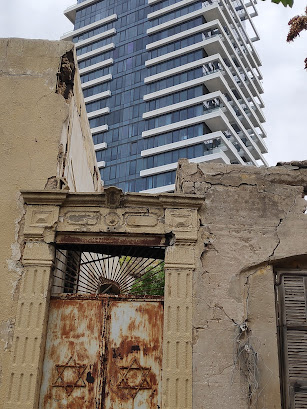
"Lo rotzim lo tzarich" (roughly : "If you don't want to make it happen , don't do me any favours") states a pissed-off Theodore Herzl in this piece of street art shot just round the corner from the rooftop. To the uninitiated, Herzl, "the visionary of the state" , provided Zionism with a motto : "im tirzu ein zu agada" ("If you want it, it's not a fairy tale") or in the parlance of
the US primaries - "Yes we can!"


As the graffiti aptly expresses, the mood in Israel today is hardly in 'yes we can' mode. In fact it's more like: "how the *&%$@# are we going to get through all this?"
Instead of Herzl's utopian vision of a well-ordered European style state, what Israelis see around them today is a sick political system, rampant corruption, threats from Hamas, Hizbullah, Iran (nuclear) a government crisis and, right now, an agonising human drama. This revolves on whether to agree to a Hizbullah offer to receive what are almost definitely the remains of Eldad Regev and Ehud Goldwasser , abducted in 2006, in return for (live) terrorist Samir Kuntar and a few of his friends. Just seen that the cabinet approved the deal
Sure, we're also to blame for some of this but what about Herzl? Wasn't it him, after all , who got us here in the first place?

Sunday, June 22, 2008

taking shots

Sagi, optically challenged but still getting the job done. "Sababa? "

After pointing and shooting for a good few years now, I finally joined a digital photography course. It's a simple affair , a few hours a week in the universita ha-amamit (popular university) which is neither a university nor - at least on a Sunday morning - popular. It seems to be run by Tel Aviv municipality and its student body (let's face it) is composed of senior citizens doing quick courses that aren't too challenging.


Our teacher is Sagi. It took me a moment to fully realise that my first photography teacher was blind in one eye. The other one seems to work pretty well though. He's running us through both the basics of photography and a better knowledge of our individual cameras. I'm on good terms with mine but I know that she could offer me much more if I could only get to know her better.

Whether or not it's a side effect, Sagi sometimes strikes his head in frustration in mid-sentence and loses his train of thought, eventually picking up the theme and invariably ending a sentence with 'sababa'? (i.e. "everything cool") . Connecting to computers and projectors can also be a lengthy affair, approached sideways with much headbanging involved until it all comes together.

The best part of the lesson is when Sagi illustrates the theme of the week (light, captured motion or whatever) with classic examples. Last week he treated us to some wonderful photos from Ansell Adams to Annie Leibowicz.

Despite the size and quality of the class (three retired ladies with names like Rina, one 40'ish guy called Amit and me) he relates to us as through we were budding photo-stars, cooing and crowing over the mediocre results of our homework ("Amazing! enchanting !"). Here's an example of last week's homework, a photo of A's cat that illustrates the warmifying effect achieved when the object is placed opposite the setting sun.

Back to the subject of the masters though, we went to see an excellent photo exhibition up the road in the main office of Bank Leumi. More specifically it was held in Beit Manne, an old house dating back to the beginnings of Tel Aviv. As is often the case, the muncipality allowedd the bank to build its tower in exchange for restoring and incorporating the historic building it would otherwise erase. In the case of Beit Manne and Bank Leumi the problem was solved by placing the old building half way inside the lobby of the new tower. Beit Manne is now being opened as a local gallery. It's good for Bank Leumi's image and relative to their profist costs them peanuts.

This is Beit Manneh from the back. In the front, its the lovely old facade that meets the street.


Anyway, the exhibition was called Shvil 6 , the reference being to shvil yisrael , the Israel hiking trail that starts in the north near Tel Dan and ends up near Eilat. Ten of Israel's best photograhers were alloted a section of the route and the results was a study in strong contrasts. Among the strongest photos were by from Pavel Wolberg, a photo journalist originally from Russia, who takes stunning and sometimes shocking shots of our often violent, ugly and absurd reality with an artist's eye. Photo buddies say Pavel is no 1 in his field and he is gaining a reputation abroad too.

Here's a link to a site about him and here are a few examples of his work to end this post.


Saturday, June 14, 2008

Zoltan Kluger

A Hagana despatcher in the 1948 War of Independence on what seems to be a stationary motorbike. I took the photos in this post at today's exhibition.

Went to see an exhibition at the Eeretz Yisrael Museum. Zoltan Kluger, Chief Photographer 1933-1958." These are official Zionist propaganda photos, some of them staged, but many of them impressive nevertheless. He also photographed Palestinian refugees (although not for the Zionist institutions) and workers clearing the rubble from abandoned Palestinian villages after the War of Independence.

Although a staunch Zionist, the Hungarian born Zoltan also had an uneasy relationship with the Zionist institutions that provided his livelihood and, like many Israeli artists even today, fretted about being unnoticed because he was working in a Levantine backwater.

Well to do residents of British Mandated Palestine taking a flight from Haifa to Tel Aviv (1930s)

"I'm suffocating," he was quoted as saying. "I'll die. I'm not progressing. I'm lagging behind other photographers in the world. The pioneers here are dying from fever, living in poverty, tired and gloomy, and I'm supposed to always photograph them laughing. I'm tired of taking photographs of laughing pioneers."

Eventually he moved to New York, opened a photo store and , until this exhibition, was forgotten.

For more on Zoltan and the exhibition see ttp://www.haaretz.com/hasen/spages/990552.html


Two boys who had survived Buchenwald concentration camp ontheir way to Palestine in an illegal immigrant ship.


A kibbutznikit on guard (or posing as such)


New immigrants from Czecholovakia arriving in their new home.


Immigrants in a transit camp in Palestine (1940s)

Two immigrants from Iran meeting after a long separation.


Father and son arriving in Palestine from Buchenwald.

Sunday, June 8, 2008

Waltz with Bashir

A few nights ago we were invited to the premiere of the much touted Israeli animated documentary 'Waltz with Bashir' . We arrived early to pick up our tickets but encountered a lengthy queue moving only at a snails pace in the airless corridor outside the Lev Cinema in Dizengoff Centre. While it was diverting to pick out the celebs in the crowd, - famous military correspondent Ron Ben Yishai , talented actess Keren Mor - it didn't make the line move any faster and we soon gave up and peeled off for home.


Last night we paid up and saw the film, without the celebs but including Ron Ben Yishai who actually appears in his own voice but in animated form. 'Waltz with Bashir' (Bashir being Bashir Jamael, the Lebanese Christian President first crowned by Israel only to be assassinated), deals with the quest of the hero, then a young soldier, to remember what he experienced in the first (1982) Lebanon War. It is brilliant and harrowing and knocks you sideways. Worth making the effort if it comes your way. You can get a taste of it at

Monday, May 26, 2008

What Italians (mainly Sicilians) have #2


An enduring infatuation with Jesus

As seen here entering a coffee bar in Altavilla, a provincial town outside Palermo.

And Mary ...Supervising a kickabout from a niche in a square in Salerno. Sicily is packed with these shrines


The most active volcano in Europe

In the shape of Mt. Etna, seen here from the patio of a friendly B&B in the undistinguished, poor but very friendly town of Randozzo which lies at the foot of the Etna range. Particles of black volcanic grit fall constantly on the good people of Randozzo who have the Sisyphian task of sweeping it up every day, lest the whole town be buried in black. It seems to be good for the plants though.


Etna erupted about a week before we arrived which lent a tang of danger to our climb of about 2,500 metres (the first 2,499.5 were done by car and cable car). The lack of oxygen, extreme cold and freezing wind made this a traumatic and exhausting experience.


The top of Etna is a brooding, ominous monster of dried lava. On the way up, driving through the gorgeous countryside full of wild flowers, we saw clearly where the lava had burned everything in its wake.


A problem with the mafia


" The mafia is a mountain of shit" Peppino Impastato , the tireless anti-mafia activist (eventually murdered by the mob) is quoted as saying on this poster marking 30 years of anti-mafia activity.

An affinity with the sea

Swabbing down the decks on a fancy yaght in the marina at Riposto.


Part of the morning catch in Riposto. There was also a massive swordfish and a very big tuna.


Click this pic to make it bigger and you'll see that this colourful awning, covering a stack of deck-chairs on the seafront somewhere on the Amalfi coast, is a ctually a photo of ... Jerusalem.


What the Italians have # 1


A vibrant culture of popular sports

Last Sunday morning , town square, Monreale, near Palermo, Sicily. A 'triathalon' was advertised but all we saw were runners of various ages. From time to time a policeman on motorbike would race round the square yelling. After about an hour of running around the narrow alleyways nearly all participants received a cup from looking local sporting dignitaries from the Union for Popular Sports. Italians also seem to be fond of "aquatic circuses".


A long and vivid history

As exemplified by this Moorish-inspired detail from a column in the beautiful Norman Duomo of Monreale. There was evidence of the strong influence of Islamic and Norman art and architecture all over Sicily, especially in the churches.


This mural from the brothel at Pompei gave us a deeply penetrating insight into the daily life of the local Romans lived before they were buried in hot ash - Sodom and Gemorrah-like - by the eruption of nearby Vesuvius.


A relaxed attitude towards life

Or at least that's how it seemed while observing this couple in Salerno. Father and son perhaps, pop in red-hot pants, strolling down an alleway, morning papers in hand, discussing the garbage crisis in Naples? Or maybe checking out a real estate opportunity in what seemed to be an emerging market (260,000 euros for 50 square metres!)


A group of fish market workers in Rispoto, Sicily, arguing at 8 o'clock in the morning. "That's Italians for you," the vegetable vendor told us. "Ten men talking and one working!" Two nights previously the mafia had set off a bomb in the newly renovated indoor fish market. On the night of our visit, local elections seemed to be underway. We decided that a Mr. Facki , on Berlusconi's list, had the least smarmy smile and announced him the victor.


Three stylish gentlemen pausing for a morning chat in Salerno. The way they're standing reminds me of an Italian version of a Pink Floyd album.


Playing an early evening game of snooker (with local rules involving little skittles on the table) in Erice, a small village perched on a mountaintop in western Sicily. The older people we came across seemed to be active and often stylish. (Sorry these photos are all of men. I have a good photo of a stylish woman but she refuses to be uploaded by the likes of me)


more to come...

Saturday, May 10, 2008

Independence Day

Once the actual anniversary celebrations got underway all the philosophising and speculating was pushed to the side and you just go with the flow. Here are some pics starting with the view from the rooftop on Wednesday night when the laser beams from the lightshow on Rabin Square could be seen behind Shalom Tower.

A street party in Neve Tzedek


and in Florentin


The flypast on Thursday looks like a replay of 9/11 but in fact the only people who were hurt were spectators on the beach, several of whom were injured when a parachutist smashed into them.


Aerial acrobatics from the rooftop.

Friday, May 2, 2008

60th celebrations 2 - flags

Half proud of the flag

The impending outbreak of Israel's 60th Independence Day (coming up on May 8) obviously triggers all sorts of middle-aged contemplations that involve comparing the naive hopes of the youthful past with the complex realities of the over-ripe present and a very uncertain future. In the media we've mostly been subjected to a series of nostalgic flashbacks (like the 'A Song for 60' competition won, predictably by Yerushalayim shel Zahav.

But in the more thinking pages of Ha'aretz at least there are some interesting reflections on where we are where we might be going . Modi Bar On is a TV producer and presenter (who has the image of the ordinary Moti-like bloke) who specialises in using plain language and old footage to dissect Israel through his historical documentary programmes:

'Bar-On is 45. His disappointment with Israel's Independence Day, and the state, is inevitable. "Now, I spend the holiday mainly at home. We used to have a cookout on the lawn. If we happened to drive around, you could see fireworks everywhere. It's become just another one of those holidays, like New Year's Eve, when you 'have' to celebrate, but it doesn't really work... We are Lot's wife. We have become petrified by looking back." Click here for the entire interview.

The most scathing indictment of Israel at 60 (on the Zionist-Israeli side that is) must come from Advocate Ya'akov Weinrot, paradoxically an ultra-successful advocate of the rich and famous, whose clients have included Ariel Sharon, Binyamin Netanyahu and billionaire/politician Arkady Gydamak. Surprisingly, Weinrot, who , it turns out, in his youth both studied in yeshivas and was a Marxist, spent most of his Ha'aretz interview bemoaning the rampant Thatcherization of Israel and the loss of all values and ideology to the destructive god of the free market. Here are a few extracts from a man who rubs shoulders with the real movers and shakers of Israeli society:

"The kibbutz movement was cast aside because it was a central obstacle to the Golden calf, to the god of finance, to Dionysus who has turned into the real god. ... I am sure that the big ideas like equality, like comradeship, like solidarity, are ideas that cannot die, they are ideas that need to rise anew. The idea of equality will arise. The idea of equality must arise.... Thatcherism sees the free market as the main thing, the foundationof all foundations, the God of all gods. Not only does it erase all other values, it conquers the queen at home.... There is no government any more. Capital is the government. Capital rules the entire expanse of experience, it flows through all the hidden veins of society....Here there are about 10-15 families controlling about 55% of all resources. In such a situation, do you really think that decisions are made in the government complex?"

No surprise then that he always looks so unhappy.

Advocate Ya'akov Weinrot


The official celebrations have the somewhat Soviet-style theme of "strengthening the nation's children", weakened as they are by a diet of pop idol shows, junk food and sms messages. If you're interested in the official anniversary site in English , here it is. But when I googled, what came up was http://israels60thbirthday.com/ which is subtitled "60 years of Palestinian suffering". Don't read it if you're interested in an Independence Day barbecue untroubled by the thoughts of how Israel's creation was also the crushing and dispersion of Palestinian society.

Some of my more politically active acquaintances will spend Independence Day in Arab villages destroyed during or after the War of Independence, to acknowldege that the liberation of one people resulted in the naqba (disaster) of the other.

Personal flag on an electricity box copyrighted just in case..

The Palestinians themselves are hatching all sorts of plans to spoil the Israeli party and bring attention to themselves. To give one example, more than 100,000 Palestinian refugees living in Lebanon are expected to march toward the border with Israel on May 14 in the context of the Palestinian Authority's plan to mark the 60th anniversary of the establishment of Israel.

The stage is ready for both Soldier's Memorial Day and the Independence Day party in Rabin Square

Troubled and guilt-ridden as well as happy and proud, we'll be on the rooftop with friends watching the flypast and the flottila, listening to the old songs on the radio and grilling our meat (and organic corn on the cob).


Happy Independence Day(naqba)!!


Sunday, April 20, 2008

Spring cleaning

Playing dominoes in Bat Yam with an abacus to keep score. Normality tinged with illusion.

Pessah, this year, at least in the area surrounding the rooftop, felt more like Yom Kippur. We took a stroll around the neighbourhood yesterday (erev chag) and a bike ride to Kiryat Shalom in south Tel Aviv this morning and were struck by the tranquility . Almost no cars on the roads, datiim (religious people) walking to and from beit knesset in their holiday best alongside chilonim (seculars) just enjoying the spring sunshine. entire families congregating on plastic chairs in courtyards and here and there the whiff of a charcoal grill from a back garden sprouting wild flowers.


In ancient times Pessah, a spring festival, was the start of the year, a much more fitting time than Rosh Hashana.


A family making a Pessah mangal (grill) in the pine wood next to low-income neighbourhood of Kiryat Shalom this morning.


One of the reasons that Tel Aviv seemed to empty out is that so many people have gone or are going abroad. Normally tens of thousands of Israelis (in a reverse exodus) would be in Sinai now but the news that the Eyptians are chasing four separate terrorist gangs there has deterred even the most diehard Sinai lovers.


Sinai, oh Sinai...


Of course you don't have to go as far as Sinai to realise that the Pessah tranquility is tinged with illusion. The Hamas managed to spoil the festive mood with a sophisticated operation at a border crossing and the IDF is in action , knocking out Hamas militants. All this just two hours drive from the rooftop.
In the missile era, in this part of the world, the space that you can safely call your own has diminished to zero. In that knowledge and in the spirit of Pessah cleaning that has gripped the country, our va'ad bayit (house comittee) has declared its determination to finally clear the junk out of the air raid shelter. Just in case.

And when flipping through the free haggadah I picked up unconsciously at the supermarket
my eyes wandered from the command to every succeeding generation to see itself as though it had been led forth out of Egypt and the text on the opposite page which began : "Spy TV :The national centre for installation of security closed-circuit TVs."

Sunday, April 13, 2008

60th "celebrations" 1

From time to time my efforts to keep this blog light and fluffy give way to an urge to delve more deeply into the complexitities, contradictions and conundrums that surround the rooftop.

This temptation has been increasing as the 60th anniversary celebrations grow inexorably closer (officially Independence Day is on May 8). The official celebrations for which no-one seems to have much stomach, have even been the subject of an on-line protest petition calling to spend the money on projects more urgen than fireworks and DJs.
The urge has also been exacerbated by a spreading feeling of national hope-less-ness, an entry into a very uncertain era in which peace is not merely difficult to attain but accepted as permanently unattainable. Consequently, the stark choice that is beginning to emerge is between apartheid (contination of the occupation with a Palestinian majority betweenthe Jordan and the Med) or Israel/Palestine as a 'state of all its citizens (i.e. no more Israel as a Jewish state).


Such an article would really have to involve a serious research job. I would have amass all the latest studies and statistics, articles and books and also do fieldwork and interview experts and opinion makers, break the whole thing down into chapter headings and provide my findings.
But why bother? The Economist has done it for me in a special report called Israel Six Decades on . I recommend taking a few minutes to read it. It's a comprehensive yet concise dissection of Israel today and the manifold challenges it is facing. Here are few quotes to whet your appetite:


"Israelis have good reason to wonder what their country will look like in 2040—or, for that matter, in 2020. Compared with much of its past, Israel's present is prosperous and secure. But its future is as uncertain as at any time in its 60 years of history."

"At some point, and perhaps quite soon, the political cost of being exposed to daily rocket fire from Gaza may outweigh that of losing dozens of troops in a massive operation to destroy Hamas's power there. That, in turn, could be the death knell of Mahmoud Abbas's leadership in the West Bank and possibly of the Palestinian Authority itself. In extremis, Israel could find itself back in charge of the occupied territories, with nobody to give the keys to, and the wheel will have come full circle."

"For the first time since 1948, real existential threats to Israel, at least in its Zionist form, are on the horizon."

"It is ironic that the fundamental disagreement between Jews and Palestinians today is not about whether there should be a Palestinian state; most Israeli Jews accepted that long ago. It is about whether there should be a Jewish one."

"If a Palestinian state does come to pass, Israel's Palestinians will face a grim choice: move there and lose their homes, or stay in Israel and lose themselves."

It is this blockage [of the political system], not Palestinian missiles or an Iranian nuclear bomb, that is the main threat to Israel's well-being. ...Israel's survival in the long term will depend on decisions taken in the near future, which will make the difference between growth and stagnation, harmony and social strife, intelligent self-defence and self-destructive belligerence. To take the right decisions it needs a system that reduces the power of special-interest groups without riding roughshod over minorities and allows long-term goals to override short-term politics. "

“…the settlers have subverted government decisions and co-opted local army commanders over the past 40 years, contriving to align the state's security interests with their own plan to populate the occupied territories. Many commentators saw their failure to stop the unilateral Gaza withdrawal as a mortal blow to their power. But they have staged a comeback.”

The Jerusalem Post devoted an editorial to criticising the special report as among other things a "tendentious reading of Israel's political landscape" but it seems to be pretty much on the mark.

More reports on the celebrations to come.

chag sameach from the rooftop